How to Mount Windows Cdrom in Ubuntu Can't Read Superblock
Universal Disk Format (UDF) refers to the ISO 13346 and ECMA-167 vendor-neutral specification for computer information storage. While in practice it'due south used to writer DVDs, there's nothing stopping someone from actually formatting a fixed disk as UDF. More practically, information technology'south used for optical media like CD-RW and DVD-RW/DVD+R to let users to add and remove files from them. Some professional high-end digital camcorders also utilise the less common DVD-RAM format, which also uses this.
Any of these formats can be hands opened in Ubuntu, and generally, whatsoever UDF volume will mountain automatically. A user simply needs to insert the optical disc and the file organization should mount. Occasionally you might find that a DVD yous authored yourself won't automatically mount in Ubuntu even if it will in Microsoft Windows, Os X or macOS Sierra. This is considering Windows will brand guesses at what the DVD contains until it gets it correct. Fortunately, a simple bash command might be all you need to become it working in Ubuntu again.
Mounting UDF Volumes to the Ubuntu File Construction
Insert the optical disc into the optical disc drive and then open up your file manager and see if it's already mounted. If information technology has, then you don't need to go further. If it hasn't, then make a quick cheque in the /media directory to run across if the operating system put it there. Ubuntu performs all automatic optical disc mounts to this location rather than the /cdrom directory used by older Linux distributions.
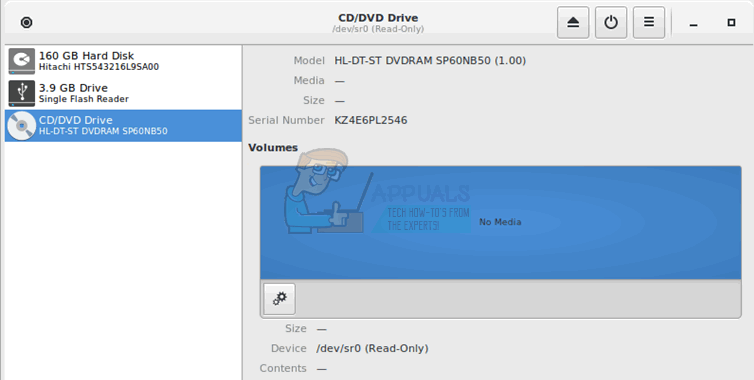
If it'due south not there, so open the Disks utility from the Dash menu or the Whisker menu if yous're using Xubuntu. Lubuntu users will notice it on the LXDE carte under Accessories. Click on the CD/DVD Drive icon in the left-hand panel and then look in the volumes graph. If there'south something in that location yet not mounted, and so endeavour clicking on the right-facing play button underneath the graph. This might mount the volume.
Disks Utility might report that there'due south No Media in the drive fifty-fifty if you know the disc is there. Take the disc out and gently clean it earlier reinserting information technology. Open up a CLI prompt by holding down Ctrl, Alt and T at the aforementioned time. Effort issuing the command sudo mountain -t udf /dev/sr0 /cdrom and pushing enter. Y'all may exist asked for your administrator password. If y'all have more than one optical drive, your device file may not mountain to /dev/sr0, and y'all'll need to use the name given in the Disks Utility in order to do so.
This command would mount the UDF file structure to the unused /cdrom directory in your root. When y'all're done working with it, make sure to unmount it with umount /cdrom before ejecting the disc. If y'all got a bad superblock fault when attempting to mountain it, then your disc might non actually be UDF formatted. If that's the example, then effort sudo mount -t iso9660 /dev/sr0 /cdrom instead and see if it mounts as a regular CD-ROM. Sometimes even a DVD+R will actually avowal the regular ISO 9660 organisation instead of the UDF format depending on how information technology was written. None of these optical volumes will mountain as anything other than read-only in terms of admission restrictions.
These steps should too piece of work when instead of a physical DVD you have a deejay paradigm that you lot downloaded from somewhere. If that'south the case, then simply replace /dev/sr0 with the bodily name of the disc paradigm. In this case, it's possible to mount a disk image on a organisation that doesn't even accept an optical drive.

Theoretically information technology's possible to create deejay images that use neither the UDF nor ISO 9660 standards. Yous tin can type more /proc/filesystems to find many of the file systems that your particular installation of Ubuntu supports. The most mutual you'll find outside of UDF and ISO 9660 include ext2, ext3 and ext4, which are the standard Linux storage formats that you're more than likely familiar with. Y'all'll besides sometimes detect images that use a vfat file system, which ways they support the FAT12, FAT16 or FAT32 standards that MS-DOS in one case promoted. Proceed in mind that if you mount with the -t vfat option, that y'all're non by definition mounting a virtual file system. While vfat does mean Virtual FAT, this refers to something other than the fact that you lot're working with a disk paradigm.
Yous could theoretically come across NTFS images as well, though these are comparatively rare. If none of the options seem to work, so effort sudo mount -t intfs ~/Downloads/theImageName.img /cdrom while replacing theImageName.img with the actual downloaded paradigm. It'southward rare that this will piece of work since NTFS is technically a FUSE extension nether Linux, so you may also wish to attempt that command with the -t fuse option too.
Since NTFS, the various Fat systems and the ext# systems aren't read-merely past definition, you'll probably want to add together either the -r or -o ro options to your mount control. This volition prevent yous from writing to the prototype, but it isn't necessary if your image was a genuine UDF or ISO 9660 paradigm, since y'all can't write to optical discs in the aforementioned way that you could to a stock-still disk or a memory stick.
It's highly unlikely and quite possibly not realistic to remember you lot would always observe a genuine optical disc with annihilation besides UDF, ISO 9660 or the various forms of CDFS for audio CDs. It's actually not possible to create some types of file systems on optical discs. Therefore, if y'all proceed to get bad superblock errors after trying both -t udf and -t iso9660 then the optical disc drive or the disc itself is probably dirty.

Source: https://appuals.com/how-to-mount-udf-volumes-in-ubuntu/
0 Response to "How to Mount Windows Cdrom in Ubuntu Can't Read Superblock"
Post a Comment