Review of Shakespeare His Wife and the Dog
The Hatch and Brood of Fourth dimension Volume I: September 28, 2020
By London Johns
Mark Antony calls to "let slip the dogs of war"; Richard 2 curses "dogs easily won to fawn on any man"; Celia insists that Rosalind's words are "too precious to be cast away upon curs." The similarity between almost every mention of dogs in Shakespeare's plays is their distaste for the creatures. When dogs are non mercilessly violent, they are lazy; when non skirting their jobs, they feign loyalty for their own do good. Shakespeare seems to dwell on dogs' worst traits, and there are enough scornful mentions in his plays that it is tempting to assume that Shakespeare himself disliked them. Shakespeare'south apparent distaste for dogs is deeply rooted in the manner that working dogs were perceived in Elizabethan civilisation. Each rank of dogs in order, from kitchen dogs to nobles' hunting dogs, is portrayed in Shakespeare's plays in a different way, and the traits they represent are as varied as the breeds of dogs themselves.
The showtime kind of working dog that Shakespeare mentions in his plays is a "curtal" or "curtail" domestic dog, or a dog whose tail has been docked. This phrase is mentioned briefly in Human activity II Scene I of The Merry Wives of Windsor: Pistol tells Ford that "hope is a curtal dog in some affairs" in response to Ford's promise that Falstaff has non pursued his wife. This line probable refers to a kitchen canis familiaris rather than a hunting canis familiaris, every bit hunting dogs' tails were needed for running and would not typically be docked. "Curtal" may carry the connotation of a common homo's rather than a nobleman's animal; thus hope is not only a canis familiaris, but a peculiarly ordinary 1. This cynical view of promise is solidified by Pistol'southward reference to the myth of Actaeon, who was transformed into a stag by Artemis and torn apart past his own hounds.

Shakespeare likewise uses the phrase "curtal dog" in The One-act of Errors. Dromio of Syracuse complains to Antipholus that Luce could have "transformed [him] to a curtal dog and made [him] turn i' thursday' bike." As a retainer working in the kitchen, Luce would take been familiar with curtail dogs, and would likely have set several to work equally turnspit dogs. Turnspits were pocket-sized working dogs ordinarily plant in kitchens commencement in the 16th century. Their function was to run in a suspended bike continued to a spit, and their motion would keep the spit turning in society to melt meals over a fire. Every bit Of Englishe Dogges, the earliest known English work on dog breeds, described their role in 1576:
"At that place is comprehended, vnder the curres of the coursest kinde, a certaine dogge in kytchen seruice splendid. For whe any meate is to bee roasted they become into a wheele which they turning rounde almost with the waight of their bodies, so diligently looke to their businesse, that no grubber nor skullion can doe the feate more cunningly."
Of Englishe Dogges praises turnspit dogs for their abilities. However, these animals were not always described in such free terms. Kitchen workers would oft throw hot coals into the turnspit's wheel to forcefulness them to continue moving or endure painful burns, and though the dogs were able to work in shifts, each was fabricated to run for several hours at a time. Grueling piece of work and constant abuse resulted in turnspit dogs being known for their bad temper. John Cordy Jeaffreson, a 19th-century novelist, called them "distorted… and graceless," hated by everyone in the kitchen and ambitious towards every fauna, including other turnspit dogs:
"Of all living creatures, your true turnspit domestic dog detested none more ferociously and implacably than his fellow turnspit. Abused past men of all degrees, and scorned past every other 'domestic dog of the house,' a pair of turnspits were continually snarling at and fighting each other… and in their common rage they would sometimes fight to the death. Buffon tells the story of a turnspit domestic dog that, on escaping from the wheel in the Duc de Lianfort's kitchen in Paris, ran in upon his fellow turnspit and killed him, considering the latter had, past skulking, compelled him to perform an additional spell of work."
This is likely the image that Shakespeare intends to convey through Dromio'south complaint. Instead of the tireless worker recorded in Of English Dogges, Shakespeare sees Jeaffreson's vehement mutt; Dromio could be trapped by Luce's affection in a torturous being, and Pistol tries to convince Ford that hope is an unpredictable and paranoid animal.
Though more favorable mentions of dogs are rare in Shakespeare's plays, they do exist. In The Taming of the Shrew, the Lord and a Huntsman appoint in a conversation that makes it clear that they are familiar and affectionate with the Lord's hunting dogs. The Lord commands the huntsman to take intendance of his hounds, and and then praises them each by proper name:
"Brach Merriman, the poor cur is emboss'd;
And couple Clowder with the deep-mouth'd brach.
Saw'st thou non, male child, how Argent made information technology skillful
At the hedge-corner, in the coldest fault?
I would not lose the dog for 20 pound."
Non only does the Lord know the names of all of his dogs, just he is able to identify their specific strengths and values them greatly. His dogs are, in fact, just as valuable to him equally his servants; servants' wages at that time were unlikely to intermission sixty pounds a year. This kind of respect for hunting dogs and for the sport of hunting was common in this period. George Turberville's 1576 Booke of Hunting documents hunting practices of the time, and spends several pages on the identification of "good and fayre" hounds. Likewise as typical physical characteristics, Turberville recommends ensuring that the dog "feareth neither water nor colde," with large nostrils that suggest "a dogge of perfect sent." The volume outlines the relationship betwixt hunter and hunting dog and recommends means for hunters to guide their dogs. Information technology paints a picture of animal-human being cooperation much deeper than the employ of turnspit dogs.
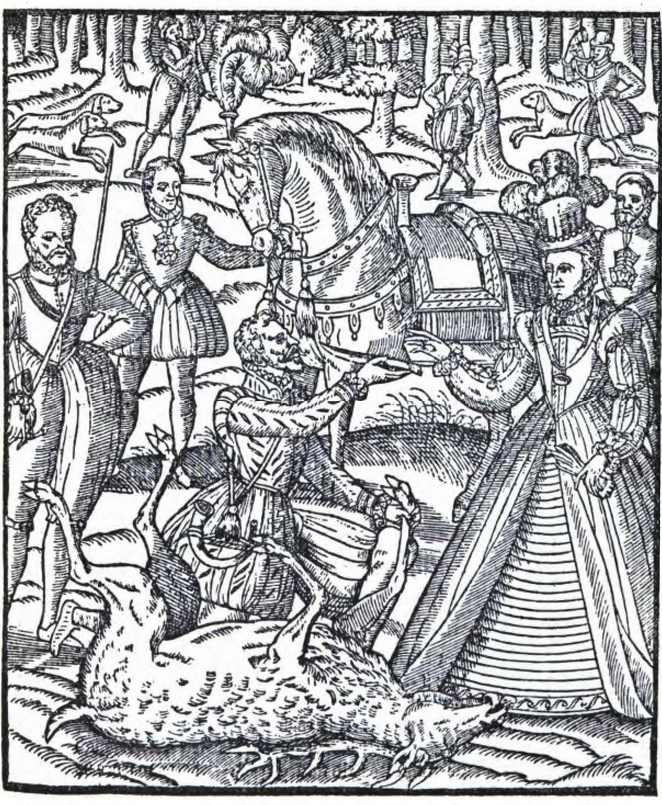
The veneration shown toward hunting dogs in Shakespeare's plays could non be more than unlike from the disdainful way in which Shakespeare writes about "curtal dogs" in The Merry Wives of Windsor and The Comedy of Errors. This disparity in the manner that Shakespeare writes about dogs conveys a similar disparity in the Elizabethan view of unlike types of dogs. Turnspit dogs were worth very little; some hunting dogs achieved a rank close to human nobility. Their status is used as encouragement in Shakespeare'due south Henry V:
"Let us swear
That yous are worth your convenance, which I doubt non,
For at that place is none of you so mean and base
That hath non noble lustre in your eyes.
I see you stand up like greyhounds in the slips,
Straining upon the start. The game'south afoot."
Henry's soldiers effort to exist as swift and determined equally their dogs, who conduct the same "noble lustre." In Shakespeare'south plays, these animals are not only the nobility of dogs, but the physical embodiment of desirable traits -- haste, agility, force, focus. Equally greyhounds embody certain ideal traits, turnspit dogs embody undesirable ones.
It is tempting to presume, from the wealth of derisive dog-related metaphors in Shakespeare'south plays, that he personally disliked them. However, to the extent that 1 can extrapolate any details of Shakespeare's own opinions from his plays, 1 finds the opposite to exist true. His curtail dogs are chaotic and violent, his greyhounds swift and precise; one can find no standard distaste for all dogs in his plays, rather a distaste for the traits that curtail dogs represent. Shakespeare's dogs are as varied as the dogs that Macbeth described to the two murderers: "The valued file/Distinguishes the swift, the slow, the subtle,/The housekeeper, the hunter, every one/According to the gift which bounteous nature/Hath in him closed."
Works Cited
Caius, John. Of Englishe Dogges. Translated by Abraham Fleming, A. Bradley, 1576. pp. 34-35
Harper, Charles. The Old Inns of Old England: A Picturesque Account of the Aboriginal and Storied Hostelries of Our Own Country, Book one. Chapman & Hall, 1906. p. 49.
Jeaffreson, John. A Volume Well-nigh the Table. Internet Annal. Retrieved 26 September 2020. Pp. 251-252.
Nares, Robert. A Glossary: Or, Collection of Words, Phrases, Names and Allusions to Community, Proverbs, Etc. Which Take Been Idea to Crave Illustration, in the Works of English Authors. Cambridge University Printing, 2011. p. 115.
Ovid. Metamorphoses. Translated by Arthur Golding. William Seres, 1567. P. lx.
Shakespeare, William. As You Similar It. Edited by Barbara Mowat and Paul Werstine, Folger Shakespeare Library, The Folger Shakespeare, shakespeare.folger.edu/. p. 35
Shakespeare, William. Henry V. Edited past Barbara Mowat and Paul Werstine, Folger Shakespeare Library, The Folger Shakespeare, shakespeare.folger.edu/. P. 87.
Shakespeare, William. Julius Caesar. Edited past Barbara Mowat and Paul Werstine, Folger Shakespeare Library, The Folger Shakespeare, shakespeare.folger.edu/. p. 113
Shakespeare, William. Macbeth. Edited by Barbara Mowat and Paul Werstine, Folger Shakespeare Library, The Folger Shakespeare, shakespeare.folger.edu/. P. 87.
Shakespeare, William. Richard Two. Edited past Barbara Mowat and Paul Werstine, Folger Shakespeare Library, The Folger Shakespeare, shakespeare.folger.edu/. p. 119
Shakespeare, William. The One-act of Errors. Edited by Barbara Mowat and Paul Werstine, Folger Shakespeare Library, The Folger Shakespeare, shakespeare.folger.edu/. p. 81.
Shakespeare, William. The Merry Wives of Windsor. Edited by Barbara Mowat and Paul Werstine, Folger Shakespeare Library, The Folger Shakespeare, shakespeare.folger.edu/. p. 53
Shakespeare, William. The Taming of the Shrew. Edited past Barbara Mowat and Paul Werstine, Folger Shakespeare Library, The Folger Shakespeare, shakespeare.folger.edu/. p. eight.
Turberville, George. Booke of Hunting. Cyberspace Annal. Retrieved 26 September 2020. p. 15. Wigstead, Henry. Remarks on a Tour to N and South Wales: In the Year 1797. Internet Archive. Retrieved 26 September 2020. p. 53.
Source: https://www.yalehistoricalreview.org/hatchandbrood1/
0 Response to "Review of Shakespeare His Wife and the Dog"
Post a Comment